The FlowSentience Framework describes how complex organisations and societies develop the capacity to perceive themselves before consequences become crises.
It began with the Sentient Value Stream Framework: a way to understand how organisations sense friction, weak signals, wellbeing, flow and adaptation inside value streams.
With The Sentience Threshold, the framework expands from organisational sensing to systemic perception at civilisational scale — connecting sentient operations, AI-assisted sensemaking, governance, planetary situational awareness and the preservation of human judgement.
Book I - Foundation:
The Sentient Value Stream Framework
Book II - Extension:
The Sentience Threshold
The Sentience Threshold extends the framework from organisational value streams to civilisation-scale perception — exploring systemic listening, planetary situational awareness, AI governance, sensemaking debt and the conditions for anticipatory governance.
-
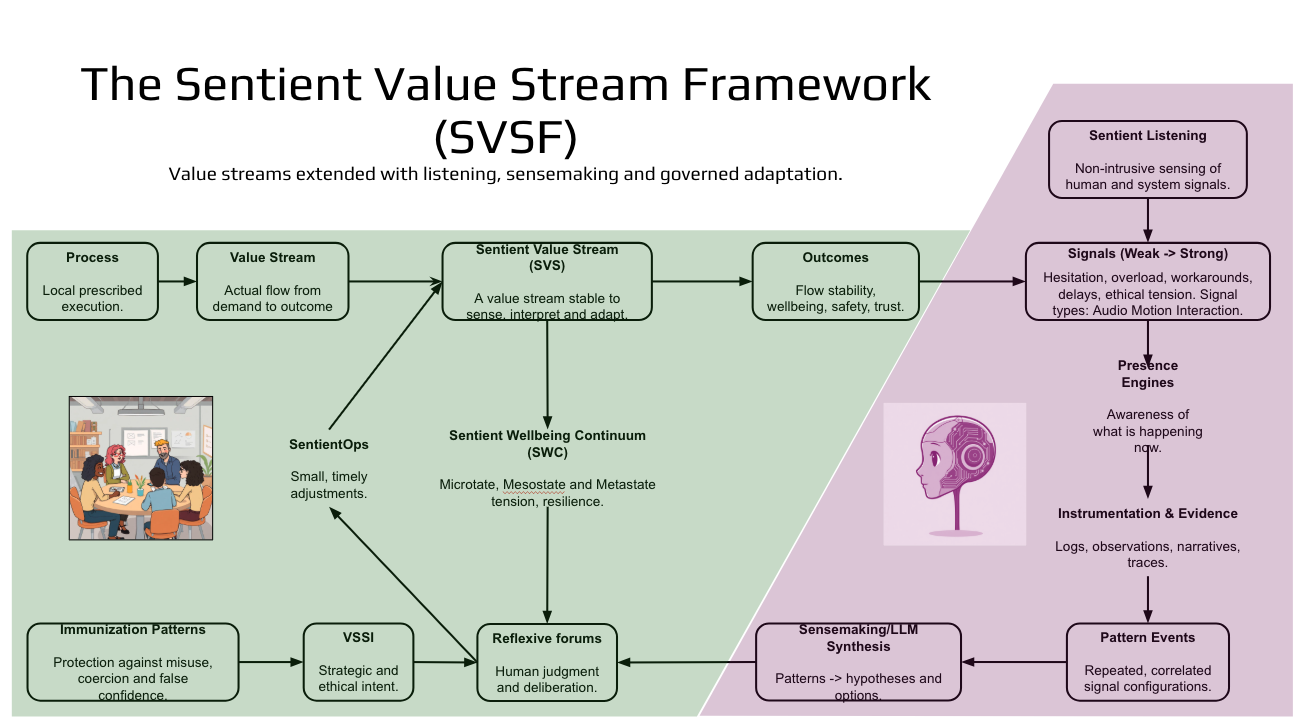
The Sentient Value Stream Framework (SVSF) extends traditional value stream thinking by embedding listening, sensemaking, and governed adaptation into the flow from demand to outcome.
It integrates structural flow (Process → Value Stream → Outcomes) with a listening architecture that detects, interprets, and responds to lived system conditions.
The framework connects operational execution with systemic awareness and ethical governance.
-
A Process represents locally prescribed execution.
A Value Stream represents the actual flow from demand to outcome.
A Sentient Value Stream (SVS) is a value stream capable of sensing, interpreting, and adapting based on lived conditions.
The SVS extends the value stream with structured listening and proportional adjustment.
-
Sentient Listening is the non-intrusive sensing of human and system signals within the value stream.
These signals may include hesitation, overload, workarounds, delays, or ethical tension.
Listening does not intervene.
It establishes awareness of lived flow conditions. -
Signals exist along a continuum from weak to strong expressions of systemic condition.
Weak signals may appear as subtle strain, delayed responses, or coordination friction.
Strong signals may manifest as repeated overload, breakdown patterns, or visible disruption.
The framework treats both as meaningful.
Signal types may include audio, motion, interaction, logs, observations, or narratives.
-
Instrumentation & Evidence refers to the structured capture of signals as logs, observations, traces, and contextual records.
It ensures that sensed conditions are not anecdotal but traceable.
Instrumentation does not replace professional interpretation; it supports it.
-
Presence Engines are proposed capabilities for bringing available signals and evidence together into contextual awareness across a value stream. Their coverage and timeliness depend on the information available and the arrangements through which it is interpreted. AI may help surface patterns and missing connections. Decision authority remains with accountable people and institutions.
-
Pattern Events are repeated and correlated signal configurations across time and context.
They represent emerging systemic tendencies rather than isolated anomalies.
Pattern Events form the basis for structured interpretation.
-
Sensemaking / LLM Synthesis transforms Pattern Events into hypotheses and possible response options.
It connects detection to interpretation.
Large language models or other AI tools may assist in synthesizing patterns, but interpretation remains subject to professional deliberation.
Synthesis informs, but does not decide.
-
The Sentient Wellbeing Continuum interprets system conditions across three levels:
Microstate – local interaction stability
Mesostate – team and coordination health
Metastate – overall systemic resilience
It translates signals into an understanding of tension and resilience across the value stream.
-
Acting consists of small, timely adjustments within the value stream based on informed deliberation.
Adaptation is incremental and governed.
-
Outcomes refer to systemic effects observable at the value stream level.
Desired outcomes include flow stability, safety, wellbeing, and trust.
-
Immunization Patterns are safeguards protecting against misuse, coercion, or overreliance on automated outputs.
They preserve professional responsibility within AI-augmented environments.
-
VSSI (Value Stream Strategic Intent) anchors all adaptation within strategic purpose and ethical responsibility.
All structural adjustments are evaluated against this intent.
-
The Sentience Threshold is a proposed condition in which society’s capacity to perceive, interpret and respond to systemic consequences becomes sufficiently responsive to its growing power to create them. The concept explores the conditions for anticipatory governance: recognising emerging consequences and acting while meaningful options remain available.
It is a conceptual proposition about civilisational governance. No universal threshold has been empirically established, and the term makes no claim about machine consciousness.
-
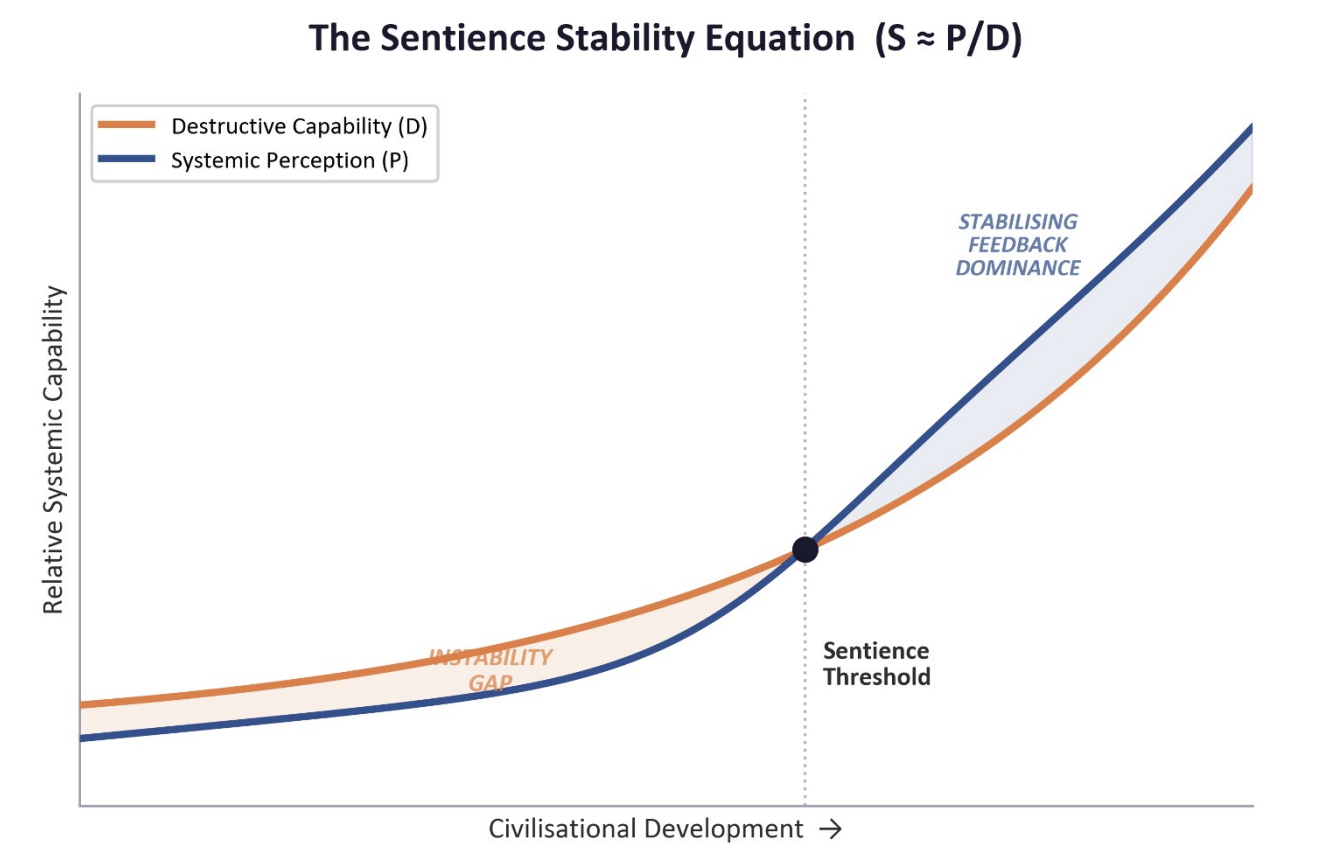
The Sentience Stability Equation, S ≈ P/D, is a heuristic expression relating systemic stability (S), collective perception capacity (P) and destructive capability (D). It illustrates the concern that a society’s power to produce consequences may outpace its ability to understand and respond to them.
The terms have no established common measurement scale. The expression and accompanying curves are conceptual illustrations, not a calibrated model, measured trajectory or predictive law. In this expression, D denotes destructive capability; it does not denote Sensemaking Debt.
-
Planetary Situational Awareness is the capacity to observe and interpret signals from interconnected planetary systems — including climate, oceans, ecosystems, infrastructure, finance, public health and migration — as parts of one evolving whole. It does not mean a single global dashboard or centralised control room. It means distributed, trustworthy and continuously updated perception across the systems that civilisation depends on.
-
Systemic Perception is the ability to see patterns that only become visible when signals from multiple domains are integrated.
A drought, for example, is not only a water issue. It may also affect energy systems, food prices, migration, public health and political stability.
Systemic perception is the shift from monitoring isolated indicators to understanding how signals interact across a complex system. -
Sensemaking Debt is a proposed latent and path-dependent organisational condition produced when consequential interpretive obligations are repeatedly carried forward without sufficient renewal and begin constraining future interpretation, coordination and adaptation.
In practical terms, work needed to clarify consequential assumptions, dependencies or purposes remains unfinished, and later activity inherits the difficulty. A Sensemaking Gap describes a momentary mismatch; debt concerns the constraints that may accumulate over time. AI can amplify both accumulation and recovery, but the condition can arise without AI. The 2026 research report develops this definition and sets out how it could be investigated.
-
Cognitive Outsourcing occurs when AI or automated systems do not merely support human understanding, but gradually replace it. Instead of using technology to extend perception, people begin to rely on machine-generated conclusions without retaining enough direct contact with the underlying reality.
The risk is not that machines become “too intelligent”, but that institutions become less capable of independent interpretation. -
Mammon Dynamics describe the tendency of economic systems to reward short-term accumulation of financial value even when that accumulation undermines long-term systemic stability.
The concept does not assume that actors are irrational or malicious. It points to incentive structures where fragmentation, opacity and delayed consequences can be profitable — and where clearer systemic perception may threaten established advantages. -
A Reflective Civilisation is a society capable of perceiving the consequences of its own actions while those consequences are still forming.
It does not eliminate conflict, uncertainty or crisis. But it changes the feedback loop: instead of learning primarily through catastrophe, it learns through continuous observation, interpretation, communication and adaptive response.
It is a civilisation that can listen to what it is doing to itself. -
Perception Capture occurs when the systems that generate or interpret systemic awareness become controlled by actors whose interests are not aligned with collective stability.
If the institutions that own the data, models or dashboards can decide which signals are visible, suppressed or emphasised, systemic listening may reinforce power rather than distribute understanding.
The architecture of perception therefore also becomes an architecture of power. -
Distributed Stewardship is the principle that no single actor should exclusively control systemic perception.
Instead, sensing, interpretation and oversight should be distributed across multiple institutions, disciplines and perspectives.
This reduces the risk of capture, improves resilience and allows different forms of expertise to challenge each other.
In complex systems, plurality is not inefficiency. It is a safeguard against collective blindness. -
The Sentient Layer is a proposed integration layer that connects existing observational systems without replacing them.
Climate science, public health, financial monitoring, humanitarian logistics and infrastructure operators already generate vast amounts of data.
The Sentient Layer would help transform these fragmented signals into shared situational awareness across domains, while preserving institutional autonomy and transparency. -
The Perception–Capability Imbalance is the widening gap between what civilisation can do and what it can understand in time.
Modern technology has expanded humanity’s ability to reshape economies, ecosystems, institutions and information environments faster than our governance structures can perceive the consequences.
The central argument of The Sentience Threshold is that long-term stability depends on narrowing this gap.